IT and Media Recycling · 5 min read
Old laptops and lithium batteries: how should your office dispose of them safely?
By Preserve Earth team, Last updated
Short answer: On 14 October 2026, a lithium-ion battery placed in the wrong bin is suspected of starting a fire at Veolia's Shrewsbury Advanced Recycling Centre, where six fire crews attended. Old laptops, phones and handheld devices carry two risks at once: the battery can catch fire if it is crushed, and the storage inside can still hold personal data. They should never go in general waste or mixed recycling. Keep them locked away and logged until a secure IT collection, with data destruction recorded for every device.
What happened in Shrewsbury?
According to letsrecycle.com, six crews from Shropshire Fire and Rescue Service were called to Veolia's Battlefield site near Shrewsbury at 17:49 on Wednesday 14 October 2026. Crews put out a fire involving recycling waste, using breathing apparatus, hose reels and a main jet. Everyone was accounted for and no injuries were reported.
A Veolia spokesperson said an investigation into the cause was under way and that initial evidence indicated the fire was caused by a lithium-ion battery incorrectly placed in a bin. The company urged people to dispose of batteries separately at dedicated recycling points.
It was not an isolated case. A week earlier, on 7 October, the London Fire Brigade sent ten fire engines and around 70 firefighters to a fire under railway arches in Bermondsey, where part of an arch used for metal recycling was damaged. The brigade said the fire was believed to have been accidental and involved a lithium-ion battery.
Why batteries in the wrong bin are a growing problem
The Environmental Services Association, which represents the waste and recycling industry, has warned that battery-related fires are now happening at what it describes as "epidemic levels", according to letsrecycle.com.
The numbers point the same way. In research reported by letsrecycle.com on 21 October 2026, Compare and Recycle sent Freedom of Information requests to all 49 UK fire and rescue services. Across the 21 services that supplied complete data, suspected battery fires at bin lorries and waste sites rose from 103 between 2019 and 2022 to 278 between 2023 and June 2026.
The reason is simple. If a battery is damaged or punctured, including during collection, compaction or processing, it can ignite. A laptop dropped into a general waste or mixed recycling bin will almost certainly be crushed on its way to be sorted.
What does UK guidance expect for old devices?
Two sets of rules apply to the same laptop.
The first is waste law. GOV.UK says businesses must sort and store waste safely and securely, complete a waste transfer note for each load that leaves the premises, and check that their waste carrier is registered.
The second is data protection. A device you no longer use can still hold staff, client or patient records. The ICO's disposal and deletion checklist expects devices awaiting destruction to be stored securely, for example in a locked area with restricted access, with a log of each device and where it is. It also expects a secure method such as wiping, degaussing or hardware shredding, and warns that information on devices that are not destroyed securely may be recoverable. We cover this in more detail in our guide to what the ICO expects when you dispose of confidential waste.
What this means for your business
If your team uses laptops, phones, handheld scanners, radios or body-worn cameras, the Shrewsbury fire is a good prompt to check what happens to them when they are retired.
- Ban devices from every bin. Make it clear to staff, cleaners and facilities teams that nothing with a battery or a screen goes in general waste or mixed recycling.
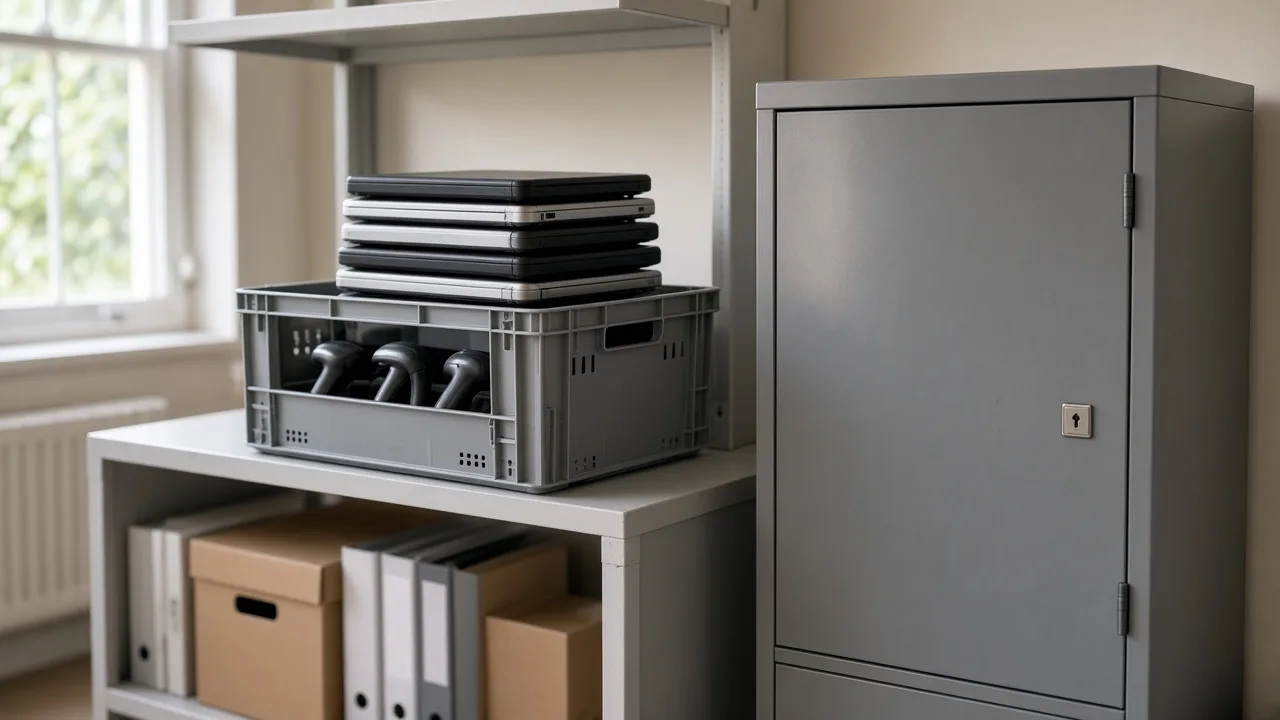
- Keep one locked place for retired kit. Store old devices together in a locked cupboard or room with restricted access, away from heat and away from paper waste.
- Log every device. Record each item, its serial number and where it is stored, so you can match it against the destruction records you receive.
- Do not let it pile up. A box of old phones in a storeroom is both a data risk and a fire risk. Book a collection after each upgrade, office move or depot refit rather than waiting for the cupboard to fill.
- Keep the paper trail. Hold on to waste transfer notes and destruction records for each collection, so you can show what left your control and when.
Logistics depots replacing scanners, security firms retiring radios and cameras, and clinics upgrading laptops are the organisations most likely to build up a store of old devices, but the same steps apply to any office.
Frequently asked questions
Can we put old laptops in our mixed recycling or general waste?
No. Devices with lithium-ion batteries can catch fire if they are crushed in a bin lorry or at a sorting site, and they may still hold personal data. Keep them separate and send them for secure IT collection and data destruction.
Should we take the batteries out of laptops before collection?
Not usually. Many laptop batteries are built in, and prising one out can damage it, which is what makes lithium batteries dangerous. Leave devices intact and mention any swollen or damaged device when you get in touch.
How should we store old devices until they are collected?
In a locked area with restricted access, with a log of each device and its location. This is what the ICO expects for devices awaiting destruction, and keeping them together and away from heat also lowers the fire risk.
Will we get proof that the data was destroyed?
Yes. Every IT collection comes with documentation and a full audit trail for your records, so you can match it against your device log.
Sources
- letsrecycle.com, "Lithium-ion battery suspected in Veolia Shrewsbury site fire" (16 October 2026): https://www.letsrecycle.com/news/lithium-ion-battery-suspected-in-veolia-shrewsbury-site-fire/
- London Fire Brigade, "Fire under railway arches, Bermondsey" (7 October 2026): https://www.london-fire.gov.uk/incidents/2026/october/fire-under-railway-arches-bermondsey/
- letsrecycle.com, "ANALYSIS: What do local figures reveal about waste fires?" (21 October 2026): https://www.letsrecycle.com/news/analysis-what-do-local-figures-reveal-about-waste-fires/
- GOV.UK, Dispose of business or commercial waste: your responsibilities: https://www.gov.uk/managing-your-waste-an-overview
- ICO, Disposal and deletion checklist: https://ico.org.uk/for-organisations/advice-and-services/audits/data-protection-audit-framework/toolkits/records-management/disposal-and-deletion/
This article is general information based on published news reports, GOV.UK and ICO guidance. It is not legal advice.