
New Textile Recycling Legislation for 2026
How new 2026 legislation on responsible textile recycling is shaping compliance, waste management and sustainability expectations for businesses.
RECYCLING ARTICLES
Marketing Team
4/3/20266 min read
Introduction to the 2026 Textile Recycling Legislation
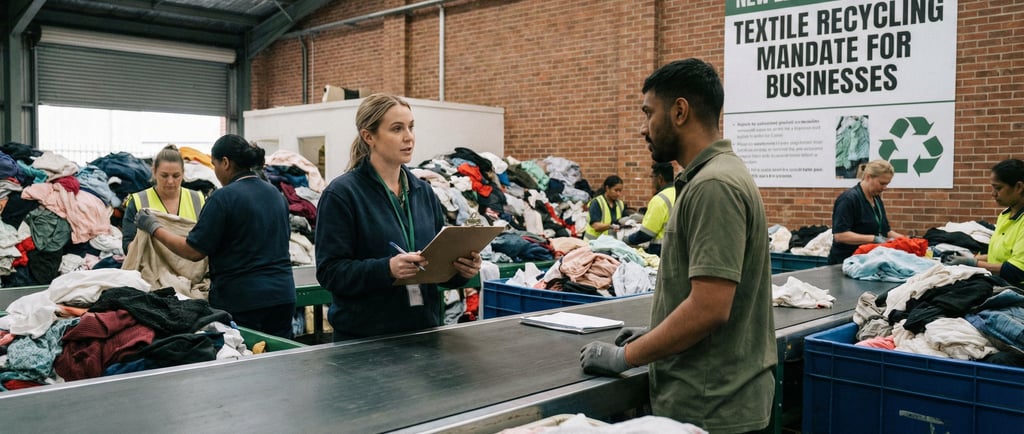
A sweeping shift in how businesses handle clothing waste is officially underway. California's Responsible Textile Recovery Act (SB 707) marks one of the most significant regulatory changes the fashion and retail industries have faced in decades - and its compliance requirements are now taking effect in 2026.
Signed into law in 2024, this first-of-its-kind legislation requires clothing producers to fund and operate take-back programs, shifting recycling costs away from consumers and municipalities. For businesses selling textiles in California, the rules are no longer optional - or distant. Understanding what's coming is essential, because the scale of the problem this law is trying to solve is far larger than most realise.
The Problem: Textile Waste and Its Impact
Understanding why textile EPR legislation emerged requires a clear look at the scale of the problem. The fashion industry generates enormous volumes of waste - globally, an estimated 92 million tons of textile waste is produced annually, much of it destined for landfills or incineration. In California alone, residents discard roughly 6 pounds of clothing and textiles per person each year, according to the Anthesis Group's breakdown of SB 707.
Existing collection infrastructure has struggled to keep pace with the volume. Donation centers routinely overflow, and a significant share of "recycled" garments are still exported or landfilled rather than genuinely repurposed. The gap between consumer intent and actual material recovery is substantial - and that gap carries real environmental and economic consequences. Exploring how textiles can be turned into recoverable resources highlights just how much value currently goes unrealised.
Producers have largely operated without accountability for what happens to their products at end-of-life - a structural flaw this legislation directly addresses. The stakes of that status quo are becoming increasingly difficult to ignore.
Why It Matters: The Stakes of Inaction
Extended Producer Responsibility textiles legislation isn't just regulatory housekeeping - it carries real financial and reputational consequences for businesses that fail to engage. Under California's SB 707, non-compliant producers face significant penalties, and the ripple effects extend well beyond state borders. As Jones Day notes, California's market scale means brands selling there effectively set a national compliance baseline.
Inaction creates compounding risk. Companies that delay face higher remediation costs, supply chain disruption, and potential exclusion from retail partnerships that increasingly require sustainability credentials. The broader manufacturing shift already underway signals that EPR compliance is becoming a baseline expectation, not a differentiator.
Understanding what's at stake clarifies why proactive planning matters - and what specific steps businesses should be taking right now.
Implementation: Steps Businesses Need to Take
The California textile law 2026 - formally known as SB 707, the Responsible Textile Recovery Act - establishes a clear framework that qualifying producers must follow. Under the law, brands selling apparel and textile articles in California must join or form a Producer Responsibility Organization (PRO), which coordinates collection, sorting, and recycling infrastructure on members' behalf. According to PlanetFWD's compliance guide, producers must register, contribute fees, and meet defined recycling targets.
Practical starting points include:
Auditing product lines to confirm which items fall under the legislation's scope
Assessing current labeling and material composition data - requirements that intersect with broader transparency frameworks like the EU Digital Product Passport
Identifying whether to join an existing PRO or co-develop one with industry peers
A recent industry report notes that scaling collection infrastructure remains the most immediate operational challenge. Waiting for full regulatory clarity before acting is a costly strategy - businesses that begin internal audits and PRO conversations now will be significantly better positioned when enforcement mechanisms activate.
How to Comply with the New Legislation
Compliance centres on one critical step: joining an approved PRO textiles organisation - a Producer Responsibility Organisation that will manage collection, sorting, and recycling infrastructure on your behalf. Under SB 707, covered producers must register with a state-approved PRO rather than building independent programs, which meaningfully lowers the operational burden.
In practice, compliance involves three core actions:
Register as a covered producer with California's designated oversight body
Join or contract with an approved PRO to fund collective recycling programs
Report sales data and verify collection targets are being met annually
According to US sustainability reporting, producers will contribute fees proportional to the volume of textiles they place on the California market - meaning larger brands carry heavier financial responsibility. Businesses already working with certified recycling partners will find the transition considerably smoother.
Compliant businesses aren't simply avoiding penalties - they're gaining a defensible sustainability narrative that increasingly resonates with regulators and consumers alike.
Understanding the finer structural details of SB 707, including exemption thresholds and PRO governance requirements, is where the real complexity lies - which the next section explores in depth.
Responsible Textile Recovery Act Guide
As textile recycling 2026 requirements take shape, understanding the Act's broader architecture helps businesses anticipate what's expected beyond immediate compliance deadlines. The Responsible Textile Recovery Act is fundamentally a shift in accountability - moving end-of-life responsibility from municipalities to producers.
A comprehensive industry analysis highlights a critical reality: infrastructure gaps remain the law's biggest implementation challenge, with collection networks needing significant expansion before recovery targets become achievable.
Businesses operating across multiple product categories should map every applicable SKU against covered item definitions now - well before program enrollment opens. Proactive supply chain audits, material transparency records, and early PRO engagement position companies to meet evolving benchmarks rather than scramble reactively. Measuring whether those efforts actually translate into verified recovery outcomes is, naturally, the next question worth examining closely.
Results & Validation: Measuring Success
How will businesses know their responsible recycling textiles programs are actually working? The Act establishes clear performance benchmarks that PROs must meet - and that producers are ultimately accountable for.
Key metrics to track include:
Collection rates against annual targets set by CalRecycle
Tonnage diverted from landfill versus prior years
Consumer participation levels across collection point networks
In practice, success validation isn't purely internal. CalRecycle reviews PRO performance plans and annual reports, creating an external accountability layer that keeps programs honest. Transparent measurement is what separates genuine circularity from greenwashing. As your compliance framework matures, it's worth exploring how your broader sustainability commitments align with these evolving standards. Of course, no compliance framework is without its complexities - and the next section examines some important caveats businesses should factor into their planning.
Limitations and Considerations
No compliance framework is without friction. Textile waste management under the Responsible Textile Recovery Act presents genuine operational challenges businesses should weigh honestly. Infrastructure remains a critical constraint - as a February 2026 industry report notes, California's current sorting and processing capacity falls well short of the volumes the Act anticipates. Smaller brands may also find PRO fee structures disproportionately burdensome relative to their market share. On the other hand, treating these challenges as permanent roadblocks rather than transition costs risks missing the broader competitive opportunity compliance creates. Understanding exactly where the Act's requirements meet real-world complexity - as the practical scenarios ahead will illustrate - is where preparation truly begins.
Example Scenarios: Textile Recycling in Practice
Abstract compliance requirements become clearer when mapped to real operational contexts. Consider a mid-size apparel brand selling into California markets: under the Act, it registers with a producer responsibility organisation, contributes fees proportional to its sales volume, and gains access to a shared collection network - eliminating the need to build infrastructure independently.
A retailer operating physical stores might designate in-store drop-off bins, coordinating pickup schedules through the PRO's logistics arm. A smaller e-commerce brand, by contrast, could leverage the collective program entirely, meeting obligations without any direct infrastructure investment.
What typically happens is that businesses discover compliance costs are more predictable than anticipated once PRO membership structures are in place - though, as noted in the previous section, rural collection gaps remain a genuine operational variable. These practical scenarios highlight that no single compliance path fits all business models, which is why understanding the strategic options available is essential before drawing conclusions.
Key Takeaways
California's Responsible Textile Recovery Act marks a structural shift - not just a regulatory update. Businesses selling textiles into California must register, contribute financially, and actively support collection infrastructure as the state pursues a genuine circular textile economy. Compliance isn't optional, and enforcement timelines are already running. The practical and financial hurdles are real, as explored throughout this article, but so is the broader opportunity: brands that build recycling into their operating model now will be better positioned as similar legislation spreads nationally and internationally.
What Is Sustainable Textiles Practices?
Sustainable textiles practices encompass the full lifecycle approach to how fabrics are designed, produced, used, and recovered - minimising environmental harm at every stage. This includes material sourcing, durability-focused design, take-back programs, and end-of-life recovery systems like those mandated under California's new legislation.
In practice, sustainable textiles aren't just about recycling; they're about reducing the need for virgin resources while keeping materials in circulation longer. Businesses that embed these principles early - rather than treating compliance as a retrofit - tend to adapt more efficiently to evolving regulations. Understanding how broader environmental commitments translate into operational policy is a logical starting point.
The next section offers a practical compliance guide to help businesses act on these principles directly.
Responsible Textile Recovery Act Guide
The Responsible Textile Recovery Act represents more than a compliance checkbox - it signals where global textile regulation is heading. Businesses that treat this legislation as a strategic opportunity, rather than a burden, will be better positioned as similar EPR frameworks expand beyond California.
In practice, early registration, proactive producer responsibility planning, and investment in circular design are the markers separating prepared businesses from reactive ones. Just as single-use disposables carry hidden environmental costs, textiles discarded without recovery infrastructure compound long-term waste challenges across industries.
Act now: Register, audit your supply chain, and engage with your producer responsibility organisation before 2026 deadlines arrive.
Follow Us
Company Number: 15482817
Preserve Earth, 2025. All Rights Reserved.