Textile Recycling · 6 min read
Can your old branded uniforms go in a textile bank?
By Preserve Earth team, Last updated
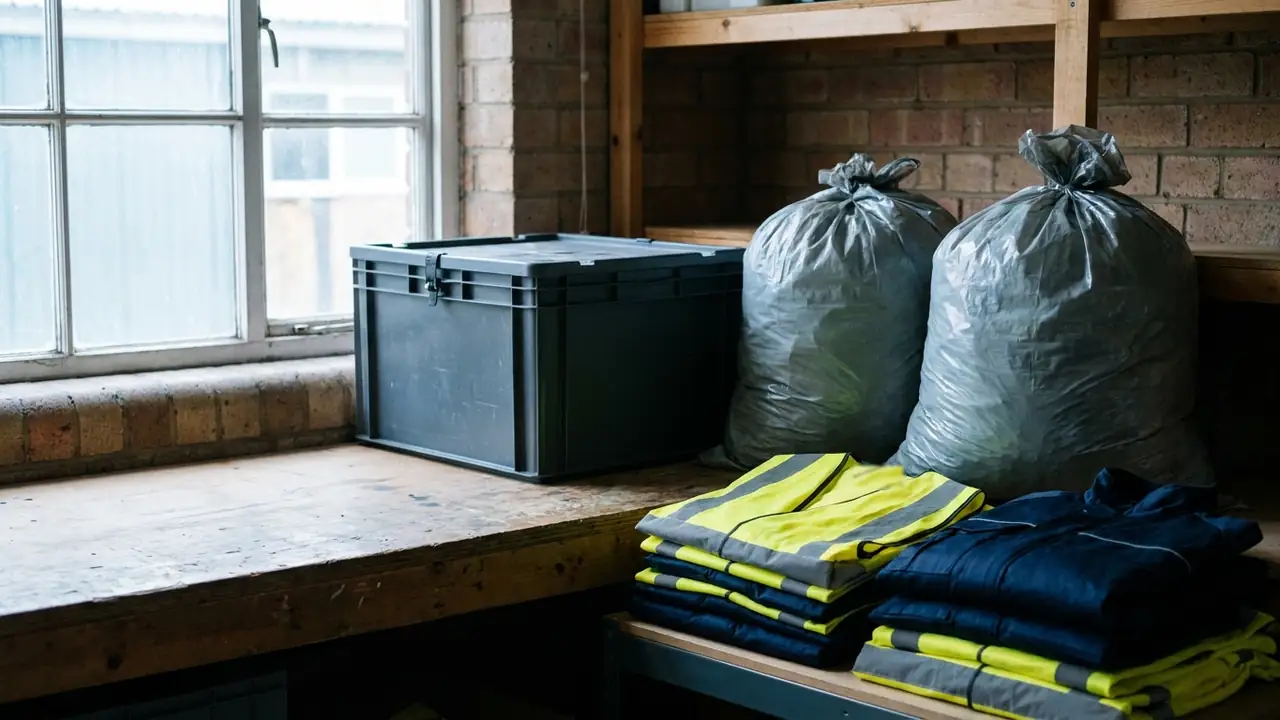
Short answer: No. Local reports this week say a resident paid a £1,000 fixed penalty notice from Wiltshire Council for leaving clothes and household waste beside a clothing bank in Warminster, and the bank has since been removed. Textile banks are under pressure across the UK, and a bag of old jackets with your logo on it is not a donation. It is business waste that could end up being worn by someone who does not work for you. Keep retired uniforms sealed and stored until a secure collection, and get a record that they were destroyed.
What happened in Warminster?
According to reports in the New Blackmore Vale on 22 October 2026 and Salisbury Radio on 23 October 2026, household waste and unwanted clothing were left on the ground next to a clothing recycling bank in Warminster, directly under a "No Fly-tipping" sign. Wiltshire Council's enforcement team found items in the waste that identified the person, who admitted leaving it, saying they thought the site was a recycling facility. They paid a £1,000 fixed penalty notice.
The container has since been removed, because it attracted regular fly-tipping and the provider was not emptying it. Councillor Martin Smith said items left on the ground quickly get scattered, damaged by the weather and attract more waste. Wiltshire Council's guidance is blunt: leaving items next to bins, recycling banks, or outside closed recycling centres and charity shops, is still fly-tipping.
It is not the only case this month. On 15 October 2026 the BBC reported that Asda had removed clothing banks at its Sinfin store in Derby, and that rubbish bags were still being left there afterwards. Derby City Council said dumping waste in this way is fly-tipping, which is illegal under the Environmental Protection Act 1990.
Why textile banks are struggling
The pressure is coming from further up the chain. On 1 October 2026, letsrecycle.com reported that the Textile Recycling Association (TRA) had warned that new Environment Agency rules for exporting second-hand textiles were seriously disrupting trade with markets such as India and Pakistan. Exporters are now being asked for evidence that receiving facilities can legally accept textile waste and recover it in an environmentally sound way. The Environment Agency said the matter was being considered internally.
The same report described a market already strained by low-value fast fashion, with merchants cutting collections and more fly-tipping at textile banks as they struggle to keep up.
On 9 October 2026, letsrecycle.com reported that WRAP had launched its Textiles Collections System Transition Programme to redesign how post-consumer textiles are collected, sorted, reused and recycled in the UK. WRAP's first report estimates that almost half (49%) of the UK's post-consumer textiles are disposed of in residual waste. The programme's blueprint is due in spring 2027. It is an industry programme rather than a new rule, so nothing changes in law for businesses today.
What does UK guidance expect from businesses?
GOV.UK says any waste from a commercial activity is business waste. That includes the hi-vis, fleeces, tunics and jackets staff hand back when they leave or when you change supplier.
For business waste, GOV.UK says you must:
- reuse, recycle or recover waste where you reasonably can, before disposal
- sort and store waste safely and securely
- complete a waste transfer note for each load that leaves your premises
- check that your waste carrier is registered
A public textile bank does none of that for you. There is no transfer note, no record of who takes the items and no say over where they go next. If staff ID cards or name badges are mixed in with the clothing, treat them like any other confidential item. Our guide to what the ICO expects when you dispose of confidential waste covers the basics.
What this means for your business
Branded clothing carries trust. A security jacket, a courier's hi-vis or a care worker's tunic can open doors, so it matters where it goes.
- Keep branded items out of public banks and skips. Make it clear to managers and staff that anything with your name or logo on it is returned, not donated or binned.
- Collect returns in one secure place. Use a lidded container or sealed sacks in a locked room, and add leavers' uniforms as they come back.
- Log what goes in. A simple note of item types and rough quantities is easy to check against the destruction record.
- Plan around refreshes. A new uniform supplier, a rebrand or a site closure can release a lot of garments at once. Book a collection before it piles up.
- Keep the paperwork. Hold on to waste transfer notes and destruction records so you can show what left your control and when.
Security firms, hospitality chains and logistics operators hold the most branded workwear, but the same steps apply to any organisation with a uniform.
Frequently asked questions
Can we donate old uniforms with our logo on them?
We would not recommend it. Once a branded item leaves your control you cannot know who ends up wearing it, and uniforms such as security jackets or hi-vis could be used to impersonate your staff. Unbranded items are a different matter, but anything carrying your name or logo is better destroyed securely.
Is it legal to put old workwear in general waste?
Workwear from your business is business waste, so it must go to a registered waste carrier with a waste transfer note. GOV.UK also expects you to reuse, recycle or recover waste where you reasonably can, and a bag of branded jackets in a general waste bin does nothing to protect your brand.
What happens to uniforms after secure collection?
Items are sealed and logged at collection, then shredded beyond recognition at secure facilities and you receive an electronic note of secure destruction. The shredded material goes to fibre-to-fibre recycling first, then into construction products where that is not possible, with energy recovery used only as a last resort. You can also request an Environmental Impact Statement.
Do you collect PPE as well as uniforms?
Yes. The service covers end-of-life textiles including uniforms, PPE and other fabric materials, branded or unbranded.
Sources
- The New Blackmore Vale, "Dumped clothes, beneath 'no fly-tipping' sign, leads to £1,000 fixed penalty notice" (22 October 2026): https://blackmorevale.net/dumped-clothes-beneath-no-fly-tipping-sign-ends-in-1000-fixed-penalty-notice/
- Salisbury Radio, "Council Warns Leaving Waste Beside Recycling Banks can still be Fly-tipping" (23 October 2026): https://www.salisburyradio.co.uk/news/local-news/council-warns-leaving-waste-beside-recycling-banks-can-still-be-fly-tipping/
- Wiltshire Council, Fly-tipping: https://www.wiltshire.gov.uk/fly-tipping
- BBC News, "Fly-tip cleared after problem clothes bank removal" (15 October 2026): https://www.bbc.co.uk/news/articles/c3rry75qd11lo
- letsrecycle.com, "TRA: Textile exports facing disruption following EA rule change" (1 October 2026): https://www.letsrecycle.com/news/tra-textile-exports-facing-disruption-following-ea-rule-change/
- letsrecycle.com, "WRAP sets out first phase of textile collections overhaul" (9 October 2026): https://www.letsrecycle.com/news/wrap-sets-out-first-phase-of-textile-collections-overhaul/
- GOV.UK, Dispose of business or commercial waste: your responsibilities: https://www.gov.uk/managing-your-waste-an-overview
This article is general information based on published news reports, council statements and GOV.UK guidance. It is not legal advice.